Everything You Need to Know About the Math
By Sue O'Connell, adapted from A Guide for Teachers, function of the Math in Do resource. What does it mean to be good at math? For many of united states of america, it was about memorizing our maths, following the standard algorithm, and getting the correct answers. Elementary math was about memory, speed, and correct answers, right? And if we could do those things nosotros were rewarded with good grades. But is that true today?Is that how we should think almost math education, whether we're teaching remotely or in person? Today our expectations for students go well beyond the ability to memorize math facts and perform bones computations. While those skills are important, nosotros recognize them as just a part of what our students need to know and be able to do. Nosotros expect our students to understand math, recall mathematically, and be able to utilize the math they take learned. This alloy of rote skills and thinking skills is not a new idea in teaching. In reading we recognize that bones skills lone do not make yous a reader. Just because a student is adept at phonics and can name sight words does non mean he tin read. How many students accept you seen who can phone call out words, only don't sympathise what they are reading? Without comprehension, calling out words is simply a rote process. Didactics facts and procedures, and hoping that understanding happens on its ain, makes as much sense as teaching phonics without attending to comprehension. The result is the acquisition of rote skills on a very weak foundation of retentiveness and with little promise for application. Nosotros want more than for our students. Our students' performance on international tests shows that they are more proficient in computations than in reasoning, justifying, or problem solving (Heibert, 2003) and that their performance falters when more complex situations are posed. So, if memorizing math facts and standard algorithms does non make a mathematician, what skills are missing? Across procedural fluency, what exercise we desire our students to know and exist able to do? Here are 10 things we want our students and to consider when planning didactics: And then much of mathematics makes sense when y'all empathize the large ideas. When students understand the counting sequence, identify value, properties, and the ways in which numbers work, math makes sense to them. We want our students to deed out situations, use physical objects, draw pictures and diagrams, or utilize abstract symbols to limited math ideas. Modeling math ideas pushes our students to think deeply almost the ideas, provides a way for them to prove their understandings and justify their thinking, and allows them to simplify math tasks and solve math problems. We want our students to be able to use their math understandings to efficiently perform a multifariousness of computations, including computations with whole numbers, fractions, and decimals. We desire our students to develop a potent understanding of numbers that allows them to compose or decompose numbers equally needed, perform computations in varied ways, make sense of various number representations, make predictions, interpret solutions, and empathise when solutions make sense. While we still value efficient procedures, we desire our students to sympathise what they are doing and why it works. When students explore math procedures through models and discussions, not just practice the procedures brand sense, but students discover important ideas about how math works. Armed with agreement, students are improve able to utilize their knowledge to new situations or problems. Past kickoff exploring math procedures through discussions and place value models, our students develop a solid foundation which later helps them brand sense of standard algorithms. Math is a series of interconnected concepts and skills, not a set of isolated skills. Seeing connections between math ideas allows students to continually build their math knowledge. Equally our students explore addition, they connect it to previous experiences with counting on. As they explore tools for measurement, they recollect about the fraction number lines they take created. Every bit they explore area measurement, they reverberate dorsum on the use of arrays in multiplication. Equally they explore decimal subtraction, they connect the new process to the known procedures for whole number subtraction and decimal add-on. The interconnectedness of math ideas allows our students to build on previous knowledge and discover important insights. We desire our students to know more than how to add, subtract, multiply, and carve up. Nosotros want them to exist able to use math skills to real situations. We want them to know when to add, subtract, multiply, or carve up. We desire them to have a strong repertoire of skills and strategies to exist able to solve complex math bug. We want our students to reason through math tasks, to analyze data, to discover insights, to exam conjectures, and to draw conclusions. We want our students to be able to precisely explain their strategies, defend their answers, describe math concepts, summarize their findings, and explain their conclusions. Nosotros desire them to communicate nearly math in talk and writing in guild to process their ideas and refine their own thinking, and in club to evidence us and others what they know. Nosotros want our students to experience confident in their math abilities, to be willing to take risks, and to persevere during circuitous tasks. We want them to love math! ♦ ♦ ♦ ♦ 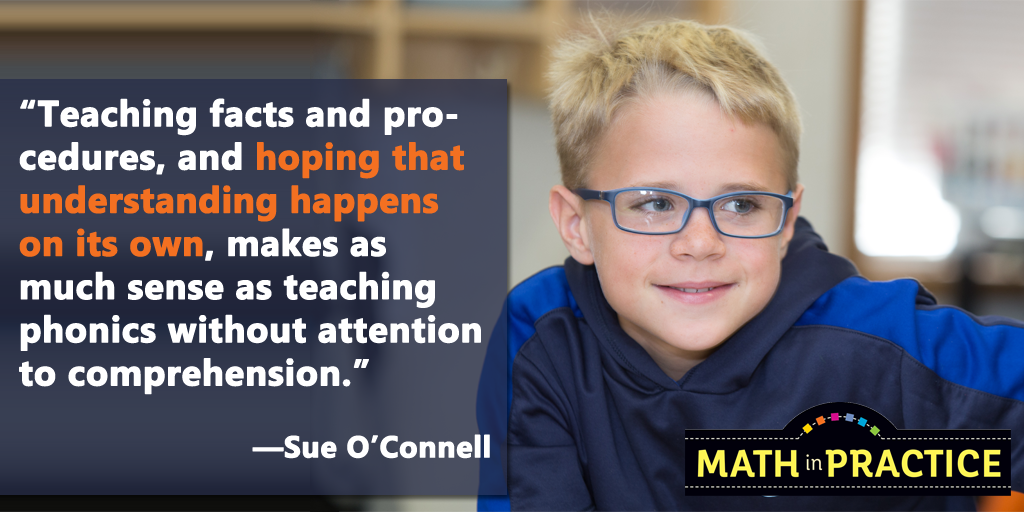
ane. Sympathise the big ideas of math.
two. Create models of math ideas.
iii. Take computational fluency.
4. Take a strong sense of numbers.
five. Understand the math procedures they do before memorizing them.
half-dozen. Understand how math ideas are connected.
7. Solve a variety of math problems.
8. Reason mathematically.
nine. Communicate their math ideas.
10. Have a positive disposition.
Larn more about Math in Practice, a Thou-5 support resource for teachers. Click here to download a digital sampler or visit MathInPractice.com to learn more.
 Sue O'Connell has decades of experience supporting teachers in making sense of mathematics and finer shifting how they teach. A former unproblematic teacher, reading specialist, and math specialist, she is also a nationally known speaker and education consultant who currently directs Quality Teacher Evolution, an system committed to providing outstanding math professional person evolution for schools and districts across the country.
Topics: Math in Practice, Mathematics, Sue O'Connell, Math, Professional Learning Resource
Source: https://blog.heinemann.com/10-things-for-math-students
0 Response to "Everything You Need to Know About the Math"
Post a Comment